























LiderCom explores the impact of AI agents on corporate communications
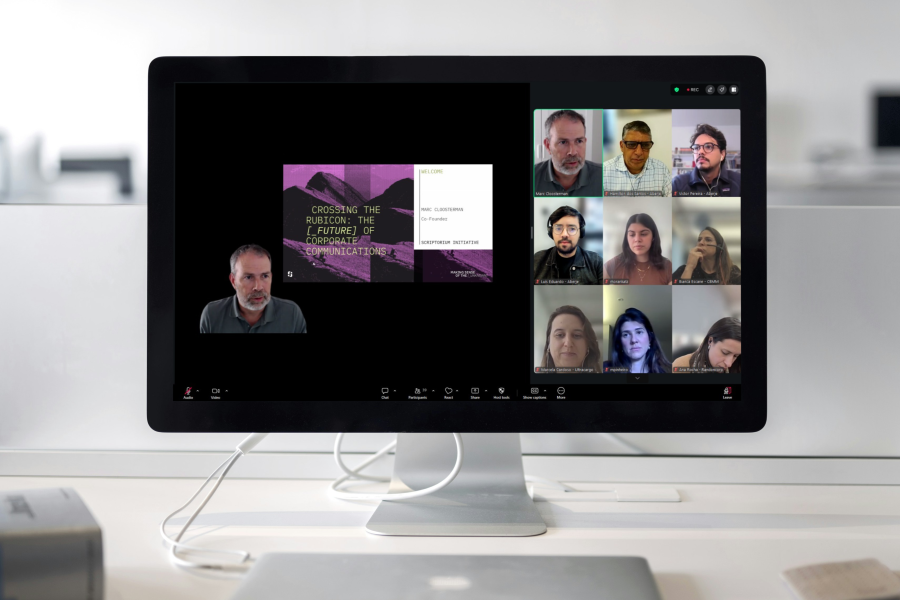
“Corporate communications is moving toward a model built around artificial intelligence agents capable of engaging in conversations, analyzing context, and operating alongside human professionals,” said Marc Cloosterman, co-founder of the Scriptorium Initiative and member of the Page Society Board of Trustees, during the event “Possible Futures,” hosted by LiderCom Aberje last Friday morning (22). Held under the Chatham House Rule and exclusively for LiderCom and LiderCom Next members, the session focused on the impact of AI on trust, reputation, governance, and the emergence of so-called “synthetic teams” or “AI-enabled communications teams.”
Opening the event, Hamilton dos Santos, Aberje’s CEO, described Scriptorium as one of the most relevant initiatives in the global debate around artificial intelligence in communications. Cloosterman explained that the project — dedicated to studying the impact of AI on communications leadership — was created about a year and a half ago following a series of interviews with CCOs from multinational companies aimed at understanding how senior executives viewed the pace of technological change.
“Seven out of eight executives talked about technology. Only one talked about how it would change human relationships,” he said. According to Cloosterman, that shift away from a purely technical perspective toward the social and organizational consequences of AI became the guiding principle behind Scriptorium, which was designed as a safe environment for leaders to reflect on ongoing transformations. He noted that the name Scriptorium itself reflects the importance of that sense of security. In medieval times, the Latin term “scriptorium” referred to the room in monasteries where monks copied manuscripts by hand — a practice tied to preserving and safeguarding knowledge.
Cloosterman argued that corporate communications is undergoing a structural transformation even more profound than the one brought about by social media. “AI is advancing faster than any technology we’ve seen before. We’re seeing exponential growth, new devices, wearables, and soon systems designed for humanoid robots,” he said.
From mass communication to AI-enabled teams
Cloosterman explained that corporate communications is shifting from a model centered on channels and content toward one built around agents capable of conversing, interpreting, making decisions, and operating continuously. In this environment, so-called “synthetic teams” or “AI-enabled teams” are beginning to emerge — hybrid structures composed of human professionals and AI agents.
Among the trends highlighted by the executive is the rise of the “synthetic stakeholder”: automated agents that consume, interpret, and respond to organizational content. Cloosterman cited examples such as body-language analysis software used by financial market analysts and the growing use of AI tools to read and consume news.
“Communication is no longer just sender-message-receiver-noise. There are now agents operating within that system,” he said. “AI doesn’t improve communication. It accelerates it.”
Another transformation discussed during the session was the shift from mass communication to “mass conversation,” in which agents are capable of sustaining multiple simultaneous interactions with different audiences. Cloosterman referenced Meta initiatives focused on developing avatars designed to interact with employees. He also showed a brief clip from the film Her — which portrays a romantic relationship between a man and his operating system — and argued that emotional connections between people and AI systems are no longer hypothetical.
Discussing how AI-enabled teams function, the executive detailed the model developed by Scriptorium over the past nine months to structure a hybrid communications team composed of humans and AI agents. According to him, the group created a synthetic team with nine agents organized around capabilities and functions rather than mirroring the traditional structure of corporate communications departments, such as internal communications, external communications, or investor relations. Within Scriptorium’s model, the agents take on nine distinct roles: editor-in-chief, project leader, communications strategist, stakeholder intelligence lead, writer, content producer, media and influencer manager, platform manager, and ethics and risk manager. The process involved everything from defining responsibilities to developing operational protocols, validation criteria, and governance mechanisms to guide agent behavior.
“We had to think about purpose, mission, values, and decision-making rules. Behavior is proof of values,” he explained. According to Cloosterman, the primary concern was ensuring that agents operated consistently with the organization’s principles, especially in situations involving conflict or ambiguity. “We also implemented rituals of honesty — verification processes, evidence logging, and protocols to determine when work is truly complete,” he added.
Each agent was developed based on profiles inspired by professionals recognized for excellence in areas such as strategy, writing, reputation analysis, and executive advisory. According to Cloosterman, although agents can handle analytical and operational tasks and maintain multiple simultaneous interactions, humans remain ultimately accountable for decision-making. “We brought humans back into the flow. They remain the final decision-makers,” he said.
The discussion also addressed ethics, technological concentration, and professional training in the context of rapid AI expansion. Asked about governance, Cloosterman said that AI-enabled teams themselves will need to incorporate functions dedicated to ethics, oversight, and alignment with organizational principles. According to him, as agents become increasingly involved in communication, advisory, and relationship-management processes, companies will need to ensure that these systems are capable of reproducing institutional standards related to responsibility, reputation, and decision-making.
“If companies are going to deploy AI agents, those agents must carry the organization’s values — because these systems will represent organizations in ongoing interactions with stakeholders,” he said. Cloosterman also noted that ethical debates are already taking place within AI development companies themselves. In his view, agents occupy a space somewhere between machines and humans, with behavior that is inherently less predictable. “We’re going to see accidents, because the technology is moving incredibly fast,” he warned.
Responding to audience questions about professional training, Cloosterman argued that organizations should adopt AI-enabled structures gradually and commit to continuous learning processes. According to him, while some of the public conversation around AI is exaggerated, companies will still need to test tools, build internal expertise, and adapt workflows before reaching more advanced forms of integration between humans and agents. “Organizations need to experiment, test, and move forward step by step,” he said. “At the end of the day, you just need to move faster than your competitors,” he concluded.
ARTIGOS E COLUNAS
Juliana Miranda Relacionamento com a imprensa: confiança que se constrói no dia a diaCarina Almeida Da opinião à evidência: o papel estratégico dos dados na comunicaçãoPaulo Nassar O comunicador e o humano
Destaques
- Study on polarization examines its impact on corporate communication
- Election cycle heightens communications and public affairs challenges across the Americas
- BRpr Highlights Research on the Evolution of Communication and Global Industry Trends
Notícias do Mercado
- Study on polarization examines its impact on corporate communication
- Election cycle heightens communications and public affairs challenges across the Americas
- BRpr Highlights Research on the Evolution of Communication and Global Industry Trends