






















Study on polarization examines its impact on corporate communication
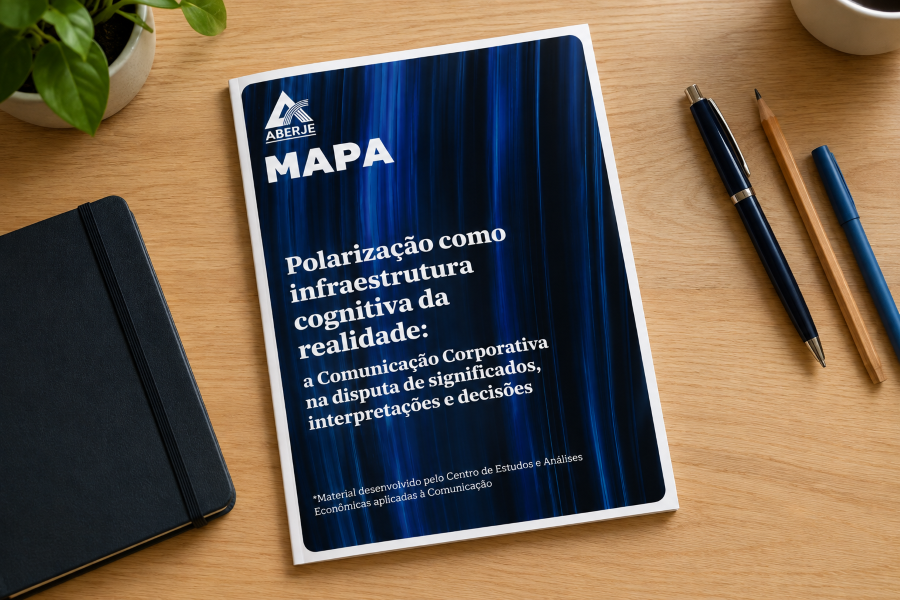
Aberje’s Center for Economic Studies and Analysis Applied to Communication (CEAEC) launched a new study on polarization this week. The latest edition of Mapa examines how polarization manifests itself across society and what it means for corporate communication, reputation and organizational decision-making. Produced by CEAEC, the publication is available exclusively to Aberje members.
Taking an interdisciplinary approach, the publication shows that polarization extends well beyond politics. It also shapes social relationships, consumer behavior, digital environments and the ways different audiences interpret corporate decisions and positions. The study draws on perspectives from Political Science, Social Psychology, Sociology, Communication, Marketing, Economics, Anthropology and Organizational Studies.
For companies, one of the implications is the growing difficulty of controlling how their decisions are interpreted. A product launch, a change in workplace policy, an investment, the adoption of artificial intelligence or a stance on a particular issue can all be viewed through different values, identities and frames of reference. The same action can therefore generate very different, and even contradictory, reactions among audiences.
Mapa focuses on Brazil, where different forms of polarization intersect with inequality, cultural identities, religion, geography, social class, generational differences and consumption habits. In this environment, commercial and institutional messages can acquire political, cultural or identity-related meanings that extend well beyond an organization’s original intent.
For corporate communication professionals, this landscape makes it increasingly necessary to understand the environments in which messages circulate and are reinterpreted. The study notes that influencers, digital communities, consumers, employees, experts, social movements and other actors all participate in shaping and contesting narratives, making traditional boundaries between internal and external audiences, consumers and citizens, and local and global contexts increasingly porous.
The publication also examines recent trends in information fragmentation, trust and changing audience behavior, while providing references for further reading on polarization. CEAEC’s analysis points to the need for continuous reputation management that can anticipate tensions, understand different systems of interpretation and maintain consistency across decisions, discourse and practices in environments where the meaning of corporate actions is constantly being contested.
ARTIGOS E COLUNAS
Ricardo Gioia O preço do silêncio na era da IALeila Gasparindo Em ano eleitoral, o silêncio da empresa também é uma mensagemRafael Calia CI Leaders: Fortalecendo a Comunidade de Lideranças da Comunicação Interna de grandes empresas
Destaques
- Study on polarization examines its impact on corporate communication
- Election cycle heightens communications and public affairs challenges across the Americas
- BRpr Highlights Research on the Evolution of Communication and Global Industry Trends
Notícias do Mercado
- Study on polarization examines its impact on corporate communication
- Election cycle heightens communications and public affairs challenges across the Americas
- BRpr Highlights Research on the Evolution of Communication and Global Industry Trends