


















Why We Need Trust Brokers. An Economic Interpretation of the Edelman Trust Barometer 2026
- The age of insularity
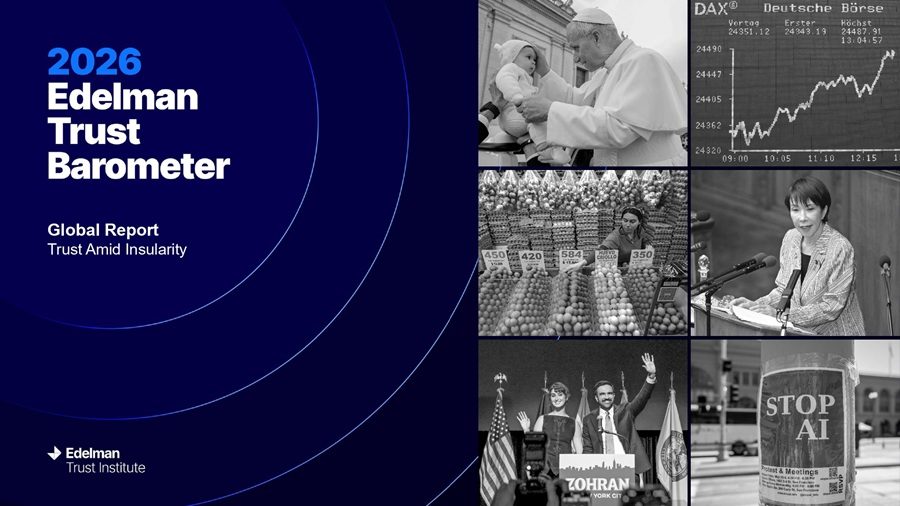
The starting point of the Edelman Trust Barometer 2026 is not so much a general “lack of trust” as a specific form of its contraction: insularity. The term matters because it shifts the problem from the broad institutional level to the level of relationships among different groups. The question is no longer simply whether people trust or distrust, but whether they are willing to trust those who live by different values, believe in different facts, rely on different sources of information, or envision different social solutions. The report’s answer is unequivocal: globally, 70% say they are hesitant or unwilling to trust someone different from themselves in these respects.
This diagnosis matters because it shows that trust no longer operates as a diffuse background condition of social life. It retreats toward what is close, familiar, and similar. The report describes this movement as “retreat into insularity,” linking polarization, grievance, and reluctance to trust those who are different. This is not merely about divergent opinions; it reflects an environment in which difference itself is perceived and assessed as risk.
The economic consequences are explicit. The report shows that unmitigated differences tend to hinder cooperation and growth: 42% would prefer to change departments rather than report to a manager with different values; 34% say they would make less effort to support a project leader with different political beliefs; and 34% would support reducing the number of foreign companies in their country even if it meant higher prices. In other words, insularity is not merely a cultural or political phenomenon—it has tangible economic consequences: it raises coordination costs, reduces productivity, and makes markets and organizations harder to operate.
At this point, the report’s central suggestion becomes particularly relevant: in the face of insularity, the path forward is not simply to call for more trust, but to invest in “trust brokerage”—that is, in practices and institutions capable of facilitating trust across difference. The formulation is compelling because it replaces the abstract language of trust with the concrete language of mediation. It is precisely this shift that opens the door to an economic reading of the problem: if trust across differences no longer emerges spontaneously, we may need to think less about restoring it directly and more about how it can be intermediated.
- What a broker does
The idea of trust brokerage points to a precise economic role: that of the broker. The broker’s function is not to produce the good or decide on the purchase, but to facilitate the meeting between parties that would otherwise struggle to complete a transaction. Brokers connect supply and demand, reduce search costs, translate expectations, organize dispersed information, and lower the risks associated with closing a deal. In opaque, heterogeneous, or highly uncertain markets, their role is fundamental to the very possibility of exchange.
Most importantly, brokerage does not presuppose homogeneity. On the contrary, it becomes more necessary precisely when there is difference, asymmetry, and difficulty of comparison. The broker exists because buyers and sellers do not know each other well, because the good is not immediately transparent, and because expectations do not automatically align. At its core, the broker’s economic function is to turn distance into transaction.
Real estate brokerage is perhaps the clearest example, as it operates in a market characterized by singularity, high value, and low transaction frequency. A property is not a standardized good: location, surroundings, condition, light exposure, neighborhood dynamics, appreciation potential, and even its history make it, in some sense, unique. Moreover, it is a high-stakes decision, surrounded by risk and relative irreversibility, that most people make only a few times in their lives. In such cases, buyers and sellers face not just pricing issues, but significant information asymmetry, difficulty of comparison, and high costs of error. This is why the broker’s role becomes central: not only connecting the parties, but translating qualities, filtering expectations, reducing uncertainty, and making tradable a good that, due to its uniqueness, would resist a purely anonymous encounter between supply and demand.
This is precisely why the notion of “trust brokerage” is so suggestive. The report itself defines it as a set of practices and behaviors aimed at countering insularity by “facilitating trust across difference,” making shared interests visible and translating needs, goals, and realities among isolated parties. From this perspective, trust does not appear as spontaneous affinity, but as something that must be mediated when difference can no longer be absorbed by the social background and impersonal mechanisms.
In this sense, the trust broker does not eliminate disagreements or necessarily produce consensus. Its role is more modest: to allow relationships to remain possible despite differences. It reduces frictions, makes the other more legible, and creates a minimum ground for mutual intelligibility. In a more insular world, this function becomes central precisely because trust no longer flows as easily as it once did.
- Trust brokers
This is where the strength of Edelman’s formulation lies. Speaking of trust brokerage suggests that, in the face of insularity, trust can no longer be treated as a diffuse feature of social life. It must be mediated. And this mediation does not occur in a vacuum: it depends on actors, institutions, and practices capable of reducing the distance between parties that no longer automatically share the same assumptions, values, or references.
In this sense, the trust broker is not very different from the broker in the broader economic sense, whose role is to make relationships viable. It connects groups, translates languages, organizes expectations, and creates a minimum level of mutual intelligibility. Rather than eliminating difference, it makes it transactable. The report emphasizes this point by framing trust brokerage as the ability to facilitate trust across difference, helping individuals isolated in their own worlds to recognize shared interests and work around common problems.
This perspective also allows us to rethink reputation. It is no longer just accumulated prestige or favorable perception—it becomes a mediation resource. A well-reputed organization is one that reduces hesitation, lowers resistance, and increases other actors’ willingness to cooperate. Its value lies not only in being admired, but in making relationships less costly and less uncertain.
Perhaps this is one of the report’s most revealing insights. On divisive issues, the action that most increases trust in companies is not simply taking a position, but encouraging cooperation among people with different views without immediately taking sides. In other words, what is now expected from organizations is mediation capacity. In a more insular environment, value accrues to those who can do what the social fabric no longer delivers on its own: enable passage between separate worlds.
- Why trust resists scale
The example of Uber helps clarify an important limit to the role of trust brokers. The platform undoubtedly performs brokerage: it connects buyers and sellers of mobility, linking passengers who need rides with drivers willing to provide them. Its basic economic function is the same as any broker’s—to facilitate matching, reduce search costs, and enable transactions. What makes this case distinctive is that it is brokerage designed to scale.
This scalability, however, does not stem from brokerage alone, but from brokerage combined with a degree of standardization. Uber does not merely connect parties; it frames the transaction in a sufficiently stable format to be repeated millions of times. Service categories, operational rules, geolocation, price estimates, and rating systems reduce variability and make urban mobility more comparable, predictable, and monitorable. The platform thus represents a specific form of brokerage—one that scales because it combines mediation with a minimum level of standardization.
This is precisely where the limits of the argument emerge when we move to trust in a broader sense. What Uber shows is that brokerage can become a platform when the relationship is sufficiently simplified. But trusting a leader, an institution, a company, or a counterpart involves far more than a narrow set of functional expectations. It involves memory, context, interpretation, vulnerability, and a situated reading of the other’s intentions. In short, trust is far richer in particularities than urban transportation.
For this reason, in the domain of trust, brokerage remains the more appropriate metaphor. The trust broker can bring parties together, translate expectations, reduce frictions, and make cooperation more likely. However, brokerage is unlikely to produce fully standardized, repeatable, and scalable interactions in the way platforms do. In matters of trust, the plausible horizon is not platform economics, but mediation—an operation that remains necessary precisely because particularity never fully disappears.
- Reputation as mediation
This is where reputation returns to the center of the argument. In an environment marked by insularity, it can no longer be understood merely as favorable perception or an intangible asset. Its most important economic function becomes mediation: reducing hesitation, making the counterpart more legible, and sustaining cooperation where trust no longer circulates spontaneously. The Trust Barometer itself suggests this by arguing that the response to insularity lies less in suppressing differences than in facilitating trust through them.
This, it seems, is the logic of the trust broker. It does not eliminate risk, erase conflict, or produce full equivalence between parties. What it does is create the minimal conditions for relationships to remain possible. And in this dimension, reputation matters less as a seal and more as an ongoing effort of translation, presence, and consistency. Not surprisingly, when the report asks what companies can do to build trust on divisive issues, the strongest answer is not to take sides, but to encourage cooperation without immediately aligning.
In my view, this is the main economic and organizational lesson of this year’s Trust Barometer. In a world shaped by insularity, trust changes regime: it ceases to be a background condition and instead requires active mediation. And precisely for this reason, reputation gains new depth—less as recognition and more as the capacity to make relationships happen. That is why we need trust brokers.

ARTIGOS E COLUNAS
Paulo Nassar A narrativa em pedra, vidro e açoPaulo Nassar O velho e o marPatricia Marins As próximas crises corporativas não virão de falhas técnicas, mas da percepção de injustiça coletiva
Destaques
- Election year heightens the relevance of Communication and Public Affairs
- Universidad de los Andes professor wins the International Aberje Award at IPRRC 2026
- Brazilian Cultural Identity on the Rise: National Identity Becomes a Strategic Asset in Corporate Communications
Notícias do Mercado
- Election year heightens the relevance of Communication and Public Affairs
- Universidad de los Andes professor wins the International Aberje Award at IPRRC 2026
- Brazilian Cultural Identity on the Rise: National Identity Becomes a Strategic Asset in Corporate Communications